
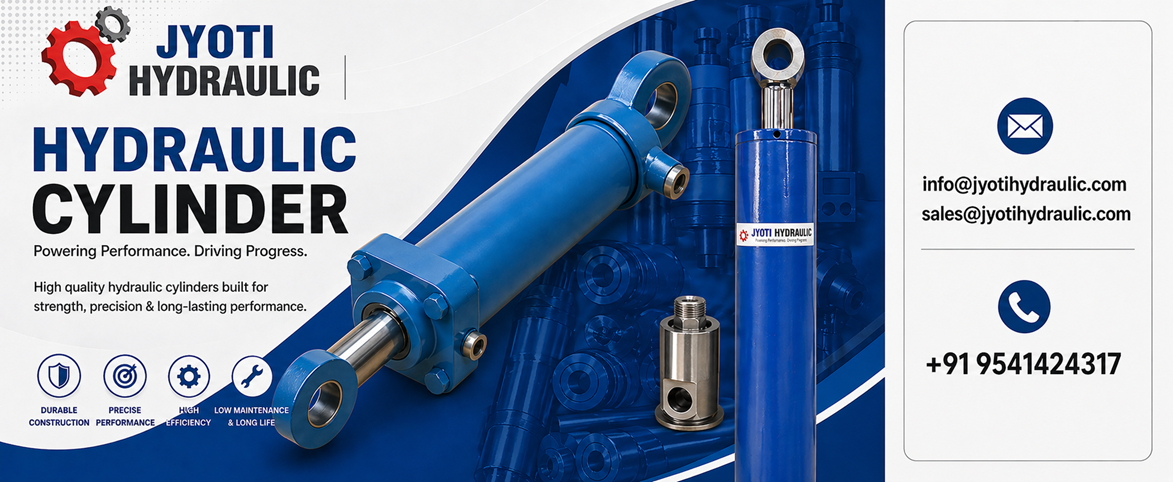
Jyoti Hydraulic develops hydraulic cylinders for machines that demand reliable force, smooth linear movement, and consistent performance under industrial working conditions. The right cylinder must do more than simply extend and retract. It must withstand operating pressure, repeated load cycles, side forces, contamination, temperature changes, and machine-specific mounting conditions. This is why choosing experienced Hydraulic Cylinder Manufacturers can have a direct impact on machine efficiency, maintenance frequency, and service life.
Industrial Hydraulic Cylinders and Their Role
Hydraulic cylinders convert fluid pressure into mechanical movement. They are commonly used where high force is required within a relatively compact space.
In industrial applications, cylinder performance depends on the complete operating system. Bore size, rod diameter, stroke, pressure, mounting style, hydraulic flow, seal type, and duty cycle must work together correctly.
For example, a cylinder used in a press may need high compressive force, while a cylinder used in material handling equipment may operate continuously with frequent changes in direction. This is why experienced Industrial Hydraulic Cylinder Manufacturers generally design or select cylinders according to actual machine conditions rather than using only standard bore and stroke values.
Key Technical Factors That Affect Performance
Bore Size
The bore determines the piston area and therefore the force available at a given hydraulic pressure. A larger bore can produce more force, but it also requires more hydraulic oil and may increase system size.
Piston Rod Diameter
Rod diameter is especially important in long-stroke applications. If the rod is too small for the applied compressive load, it may bend or buckle. Proper rod sizing improves structural stability and operating reliability.
Sealing System
Hydraulic cylinders use seals to control fluid leakage and maintain pressure. Seal selection should consider pressure, temperature, speed, hydraulic fluid, and contamination.
Poor seal selection can lead to internal bypass, external leakage, friction, and premature cylinder failure.
Surface Finish and Alignment
Rod surface quality affects seal wear and leakage. At the same time, correct cylinder alignment is essential because excessive side loading can damage the rod, gland, seals, and guide components.
Double Acting Hydraulic Cylinders
Double acting cylinders use hydraulic pressure for both forward and return movement. This makes them suitable for machinery requiring controlled motion in both directions.
Reliable Double Acting Hydraulic Cylinder Manufacturers must account for the difference between extension and retraction force. During extension, hydraulic pressure acts on the full piston area. During retraction, the piston rod reduces the effective area, which normally results in lower available force.
This difference should be considered during machine design, especially where pulling force is as important as pushing force.
Common Applications
Industrial hydraulic cylinders are widely used in:
- Hydraulic presses
- Steel processing equipment
- Material handling systems
- Agricultural machinery
- Construction equipment
- Clamping and lifting mechanisms
- Special-purpose machines
- Automation and positioning systems
The required cylinder design can vary significantly between these applications.
How to Choose the Right Hydraulic Cylinder
Before ordering a cylinder, buyers should clearly define the required force, stroke, working pressure, maximum pressure, operating speed, mounting arrangement, and duty cycle.
The working environment should also be considered. Cylinders operating in dusty, wet, hot, corrosive, or outdoor conditions may require different seals, wipers, surface protection, or materials.
It is also useful to provide installation drawings, existing cylinder dimensions, or machine layout details when requesting a replacement or customized cylinder.
Why Choose Jyoti Hydraulic?
Jyoti Hydraulic focuses on matching the hydraulic cylinder to the actual machine requirement. Instead of selecting a cylinder only by bore and stroke, factors such as loading condition, rod stability, operating pressure, mounting, sealing, and environmental exposure are considered.
This application-focused approach can help reduce problems such as leakage, uneven movement, premature seal damage, rod wear, and unexpected downtime.
Future Trends
Industrial hydraulic systems are becoming more connected with sensors, position monitoring, pressure feedback, and automated controls. Smart monitoring can help identify abnormal operating conditions and support preventive maintenance.
Energy efficiency is also gaining importance, encouraging better cylinder sizing and improved hydraulic circuit design.
Frequently Asked Questions
What details are needed before selecting a hydraulic cylinder?
Required force, stroke, pressure, rod diameter, mounting, speed, duty cycle, and working environment should be considered.
Why is a double acting cylinder used?
It provides powered movement in both extension and retraction directions.
What causes hydraulic cylinder failure?
Common causes include contamination, incorrect seals, excessive pressure, side loading, poor alignment, and rod damage.
Can hydraulic cylinders be custom-made?
Yes. Bore, stroke, rod size, mounting, ports, seals, and dimensions can be customized according to the application.
Conclusion
Choosing the right Hydraulic Cylinder Manufacturers is important for obtaining a cylinder that suits the machine rather than simply fitting into available space. Proper engineering can improve performance, reliability, and maintenance life.
For industrial, customized, or double acting hydraulic cylinder requirements, contact Jyoti Hydraulic.
Request a quotation or speak with an expert for application-specific guidance.
📧 info@jyotihydraulic.com
📞 +91 9541424317


